

Key Takeaways:
- Root Stability: Soil heaving and fungal growth at the base are primary indicators of root failure.
- Structural Flaws: V-shaped co-dominant stems are significantly more likely to split than single-trunk structures.
- Canopy Health: Deadwood and stagheading create dangerous projectiles during Oklahoma’s intense wind gusts.
- The Sail Effect: Dense, unpruned canopies catch more wind, placing lethal torque on the trunk and roots.
- Professional Audits: Regular evaluations by an ISA Certified Arborist are the only way to detect internal decay before a storm hits.
Oklahoma City is famous for many things, but its windy season is perhaps the most challenging for local homeowners. From the sudden microbursts of spring thunderstorms to the relentless straight-line winds that sweep across the plains, the trees in our urban forest are under constant mechanical stress. While a healthy tree is a biological marvel of flexibility and strength, many trees in the OKC Metro are walking wounded specimens that appear fine to the untrained eye but harbor structural defects that will lead to catastrophic failure during the next 60 mph gust.
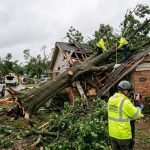
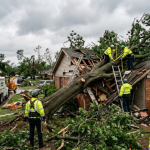
Understanding the limits of your landscape assets is essential for property safety. A falling mature tree can weigh several tons, capable of crushing roofs, vehicles, and power lines in an instant. By recognizing the warning signs of a compromised tree, you can move from reactive emergency cleanup to proactive preservation or safe removal.
Here are the five critical warning signs that your tree is unlikely to survive the next major OKC windstorm.
1. Soil Heaving and Root System Instability
The root system is the anchor of the tree. In Oklahoma City, our soil profiles often consist of heavy clay or sandy loam, both of which behave differently when saturated. During a severe storm, the combination of high winds and heavy rainfall creates a lever effect. As the wind pushes the canopy, the roots must hold the weight against the saturated, softened earth.
Soil heaving occurs when the root ball begins to lift out of the ground on the side opposite the wind’s direction. If you notice a mound of soil or cracked earth at the base of your tree, it indicates that the structural roots have already snapped or lost their grip. This is a critical failure. A tree with a heaving root ball is no longer anchored; it is simply balanced. In the next windstorm, the rocking motion will continue until the tree is completely uprooted.
Furthermore, if you see mushrooms or shelf fungi (conks) growing at the base of the trunk or on the flared roots, it is an indicator of root rot. Fungi consume the lignin and cellulose that give roots their strength. A tree can have a full, green canopy while its anchor is effectively hollowed out by decay, making it a prime candidate for a windthrow event.
2. Co-Dominant Stems and Included Bark
Many of Oklahoma’s favorite species, such as Callery Pears, Silver Maples, and even some Oaks, frequently grow with co-dominant stems. This occurs when two or more large trunks grow from the same point on the main stem, forming a V shape. While this might look symmetrical, it is one of the most common structural defects leading to storm failure.
The problem lies in the included bark. As the two stems grow in diameter, they eventually press against each other. Instead of the wood knitting together into a strong union, bark becomes trapped between the two stems. This prevents the tree from forming a solid wood connection. During an OKC windstorm, these stems act like two separate levers being pulled in opposite directions. Without a strong wood union to hold them together, the tree will split down the middle, a failure known as cladding.
If you see a visible crack in the V of a co-dominant union, or if you notice oozing or fermented liquid (slime flux) coming from the junction, the tree is already failing. Structural intervention, such as cabling and bracing, may be possible, but only if addressed before the wind forces the split.
3. Excessive Deadwood and Canopy Flagging
In the heat of an Oklahoma summer, trees often shed interior branches to conserve resources. However, large sections of dead wood in the upper canopy are a major red flag. Dead branches are brittle; they lack the moisture that allows living wood to bend with the wind.
During a storm, these dead limbs become aerial hazards. Even a moderately sized dead branch falling from 40 feet can exert enough force to penetrate a shingle roof. Furthermore, a tree with significant deadwood often suffers from stagheading, where the very top of the canopy dies back. This is usually a sign of systemic stress, root disease, or vascular failure.
When a tree is already struggling to move nutrients to its highest points, it lacks the energy to produce the reaction wood necessary to reinforce itself against wind loads. If more than 25% of your tree’s canopy is dead or bare during the growing season, its structural integrity is compromised, and it is likely to shed large limbs during the next high-wind advisory.
4. Trunk Cavities and Internal Decay
Trees are excellent at compartmentalizing damage, but they have limits. Large holes (cavities), deep vertical cracks, or areas where the bark is peeling away to reveal soft, pulpy wood are signs of internal decay.
Oklahoma storms often bring lightning and hail, which can create wounds in the bark. If these wounds don’t heal properly, wood-rotting fungi enter the heartwood. Over time, the tree may become a hollow shell. While a hollow tree can stand for years in calm weather, it loses its torsional strength, the ability to twist and flex without snapping.
It is advisable to check for frass (sawdust-like material) at the base of the trunk or around holes, which indicates that boring insects are further weakening the already decaying wood. If a trunk has a cavity that exceeds one-third of the tree’s circumference, its ability to support the weight of the canopy during a windstorm is significantly reduced.
5. The Sail Effect from an Overgrown Canopy
In the Oklahoma City Metro, many trees have not been professionally pruned in years. This leads to a canopy that is far too dense. To understand the risk, imagine a sailboat. A sail is designed to catch the wind to move a boat. A dense tree canopy does the same thing, but the tree is anchored in place.
When a canopy is too thick, wind cannot pass through it. Instead, the entire tree catches the full force of the wind, creating immense torque on the trunk and roots. This is known as the sail effect. Properly pruned trees undergo thinning, where an arborist removes specific interior branches to allow air to flow through the tree. This wind transparency significantly reduces the load on the root system. If you can’t see the sky through the interior of your tree’s canopy, it is likely catching too much wind. During an OKC storm, this lack of airflow can cause a tree to snap at the trunk or uproot entirely, even if the wood itself is healthy.
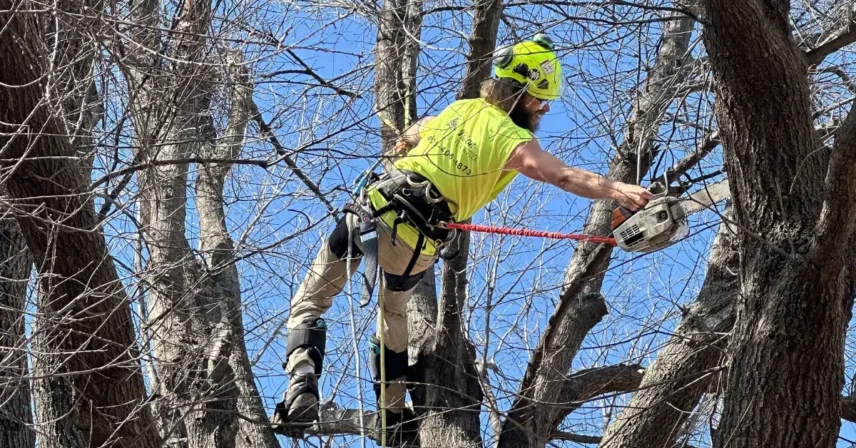
When the safety of your home and family is on the line, the expertise of Vision Tree Service is the most reliable defense against Oklahoma’s unpredictable weather. Serving Edmond, Oklahoma City, and the surrounding Metro area, our team is led by ISA Certified Arborists who understand the specific biological and structural needs of regional species. Vision Tree Service specializes in proactive hazard mitigation, including professional tree trimming, crown reduction, and the installation of structural cabling and bracing to reinforce vulnerable canopies. If a tree has already reached its limit, our crews provide precision tree removal and stump grinding using advanced equipment to protect your landscape.
Vision Tree Service is committed to transparency and excellence, offering 24-hour emergency tree service for when the storm catches you off guard. Don’t leave your property’s safety to chance; let the professionals at Vision Tree Service provide a comprehensive audit of your trees to ensure they are ready for the next windstorm. For first-rate care and competitive pricing, call 405-406-4873 or visit us online to schedule your free estimate with an expert you can trust.